The Symbolic Filter: What If the Great Filter Is Not About Thinking, But About Saying It?
Here's something that's been bugging me.
In 1950, Enrico Fermi asked the most famous lunch question in history: "Where is everybody?" The universe is absurdly large, absurdly old, and filled with an absurd number of planets that could host life. If intelligent life is even slightly probable, the galaxy should be crowded. It isn't. The sky is silent.
Robin Hanson called this problem the Great Filter [1] — the idea that somewhere between dead rock and interstellar civilization, there's at least one step so improbable that essentially nobody makes it through. The usual suspects are abiogenesis, eukaryogenesis, multicellularity, or civilizations nuking themselves into oblivion [1][2].
All reasonable. But I think there's a candidate that's been hiding in plain sight, scattered across three academic literatures that don't talk to each other. After digging through the astrobiology, cultural evolution, and evolutionary linguistics literature pretty extensively, I haven't found anyone who's put the pieces together into a single argument.
The candidate: the ability to build shared symbolic systems with high transmission fidelity. I'm calling it the Symbolic Filter.
Let me explain.
Smart doesn't mean civilized
The first thing to get straight is that intelligence and civilization are not the same thing. Not even close.
On Earth, "raw" intelligence — problem-solving, tool use, mental models of the world — has evolved independently multiple times. Crows make tools and adjust them to the task. Octopuses solve puzzles with a nervous system that looks nothing like ours. Dolphins have complex social lives and elaborate communication. Chimps plan ahead, deceive each other, and play politics.
None of them have ever built anything remotely resembling a civilization.
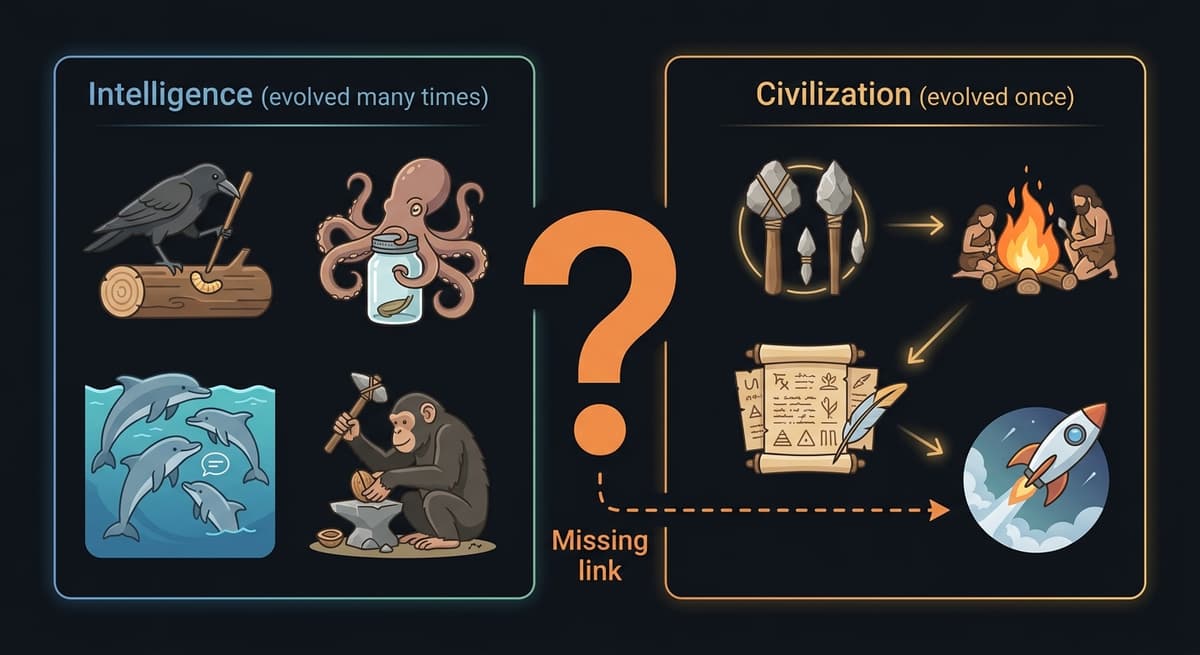
This isn't because they're stupid. It's because they're missing something else — something that the Great Filter literature has been weirdly slow to isolate.
Snyder-Beattie, Sandberg, Drexler, and Bonsall (2021) built a Bayesian model of evolutionary transitions and included "the emergence of language and intelligence" as one of their steps [2]. But it's a single step. They never ask: what if intelligence is easy and language is hard? What if those are two completely different bottlenecks?
Mills et al. (2025), in the most comprehensive survey of proposed hard steps to date, confirm that language doesn't appear as a separately proposed step in any formulation they reviewed [7]. It's always lumped under "Homo sapiens" alongside tool use, consciousness, and theory of mind.
I think that's a mistake. Here's why.
The real question
The filter isn't: "Can they think?"
It isn't even: "Can they talk?"
It's:
Can they transmit complex information across generations without losing it?
That's an information theory question, not a linguistics question. And it breaks down into three variables that I'll use throughout this post:
- I — Individual intelligence. How good a single agent is at solving problems.
- T — Transmission fidelity. How much information survives when passed from one agent to another, and from one generation to the next.
- C — Cumulative complexity. How sophisticated the technology and culture of a population can get.
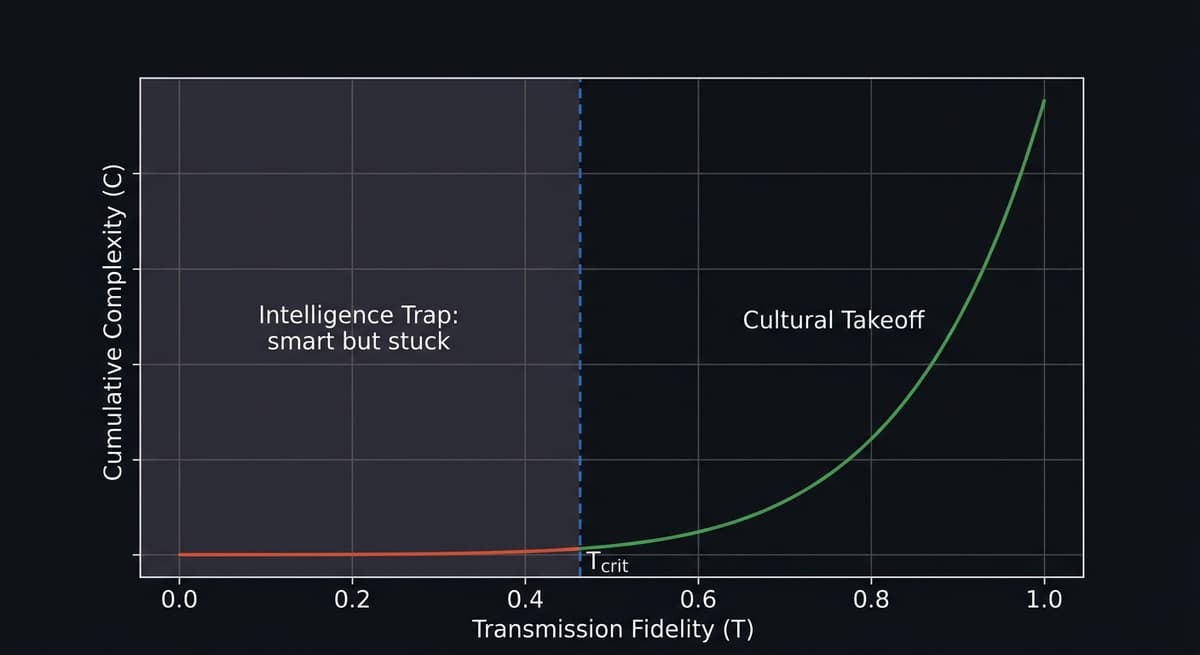
The key insight — and the one I haven't seen anyone formalize in the context of the Fermi Paradox — is that C depends on T much more than on I.
A planet full of geniuses with bad transmission produces brilliant individuals who solve amazing problems and then die, taking the solutions with them. Every generation starts nearly from zero. A planet full of average minds with excellent transmission builds the wheel, then the cart, then the road, then the trade network, then writing, then calculus, then rockets.
The Symbolic Filter is the threshold of T below which cumulative culture can't ignite — no matter how high I is.
Why copying isn't enough
This is where I have to win the argument. If imitation alone — without symbols — can produce cumulative culture, my whole hypothesis falls apart.
Imitation transmits procedures: watch someone do something, then reproduce it. It can work pretty well — macaques have washed sweet potatoes for generations, New Caledonian crows pass down tool designs [3][8]. But it has two structural problems that I think are fatal for getting past the threshold.
Problem 1: imitation copies whole blocks, not components. When a crow copies a tool-making technique, it copies the entire sequence as one opaque chunk. It doesn't extract "bending" and "cutting" as separate reusable principles. Without decomposition into components, there's no recombination. And without recombination, you only get incremental variations on the same tradition. You never get composition — combining two unrelated traditions into something new.
Problem 2: imitation transmits the "how" without the "why." If you don't understand why a technique works, you can't fix it when it breaks, adapt it to a new context, or teach it efficiently. Every variation of context requires a new demonstration from scratch.
The result: imitation gives you linear growth at best. Symbolic transmission gives you combinatorial growth — components recombine, innovations in one domain fertilize others [9][10].
The difference between linear and combinatorial is the difference between washing potatoes for ten thousand years and going to the moon.
Making it formal: the ODE
I can make this more precise with a simple model. Think of the cumulative complexity of a population as governed by:
Where scales individual innovation, is the rate of social sharing, is cultural decay (people die, things get forgotten, scrolls burn), and is effective transmission fidelity.
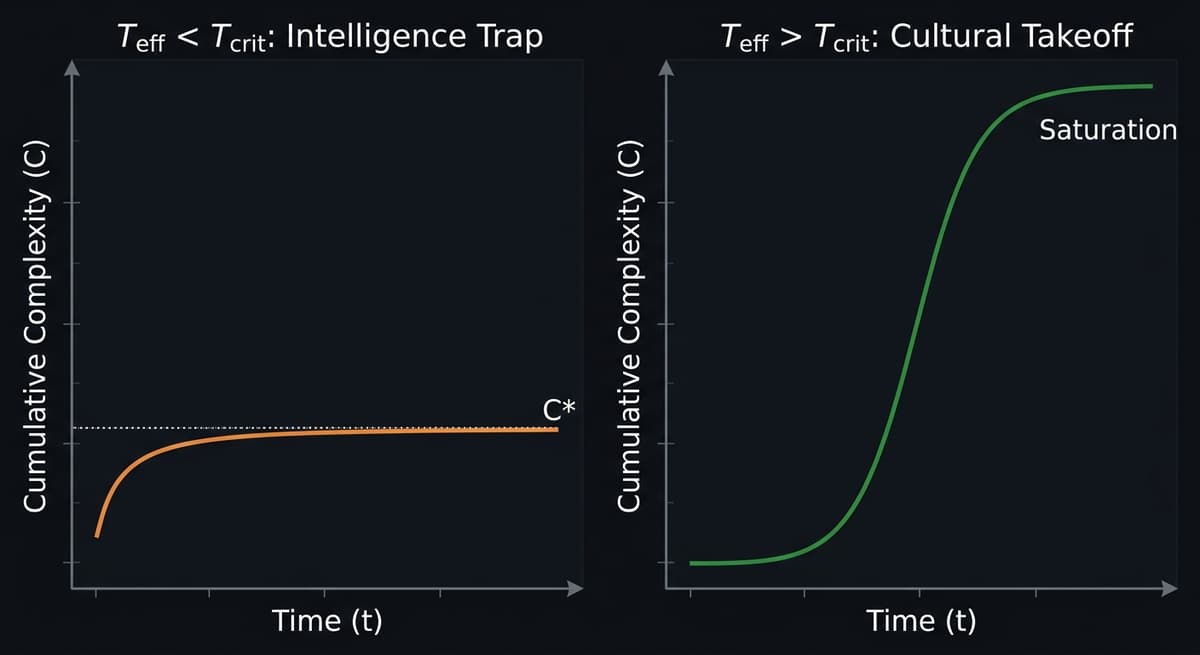
This is deliberately simplified — constant parameters, homogeneous population, uniform mixing. Real life is messier. But the qualitative structure is what matters, and it's robust: this equation has two completely different regimes depending on the sign of .
Below the threshold (): complexity plateaus at
Higher intelligence raises the ceiling, but the ceiling stays. This is the regime of smart animals — corvids, cephalopods, cetaceans. Brilliant individuals, zero civilizations.
Above the threshold (): complexity goes exponential
The threshold itself is:
This is a bifurcation — a qualitative phase transition, not a smooth gradient. Below , you can wait a billion years and nothing happens. Above it, takeoff is inevitable.
(In reality, the exponential doesn't run forever. Mesoudi (2011) showed that rising learning costs turn it into a logistic with a saturation plateau [11]. But the key distinction — stuck vs. takeoff — holds.)
Borrowing from Eigen — carefully
Why is so hard to reach? Here I want to borrow a concept from molecular biology, but I need to be honest about where the analogy works and where it doesn't.
Manfred Eigen (1971) proved that self-replicating molecules (like RNA) can only maintain their information if the per-nucleotide copying fidelity is high enough [12]. If errors get too frequent, the information dissolves into noise — the error catastrophe. The maximum sequence length a system can maintain is:
where is per-unit fidelity and is the selective advantage of the master sequence [12].
The principle behind this — any transmission system with errors has a finite limit on maintainable complexity — is not specific to chemistry. It's information theory. It applies to culture too.
But here's where I have to be careful, because the analogy breaks in three important ways.
Break 1: cultural errors aren't random and independent. In DNA, an error at position 47 doesn't affect position 48. In culture, if you misunderstand the principle behind a technique, you get cascading errors across everything that depends on it. The model assumes independence, which is wrong for culture.
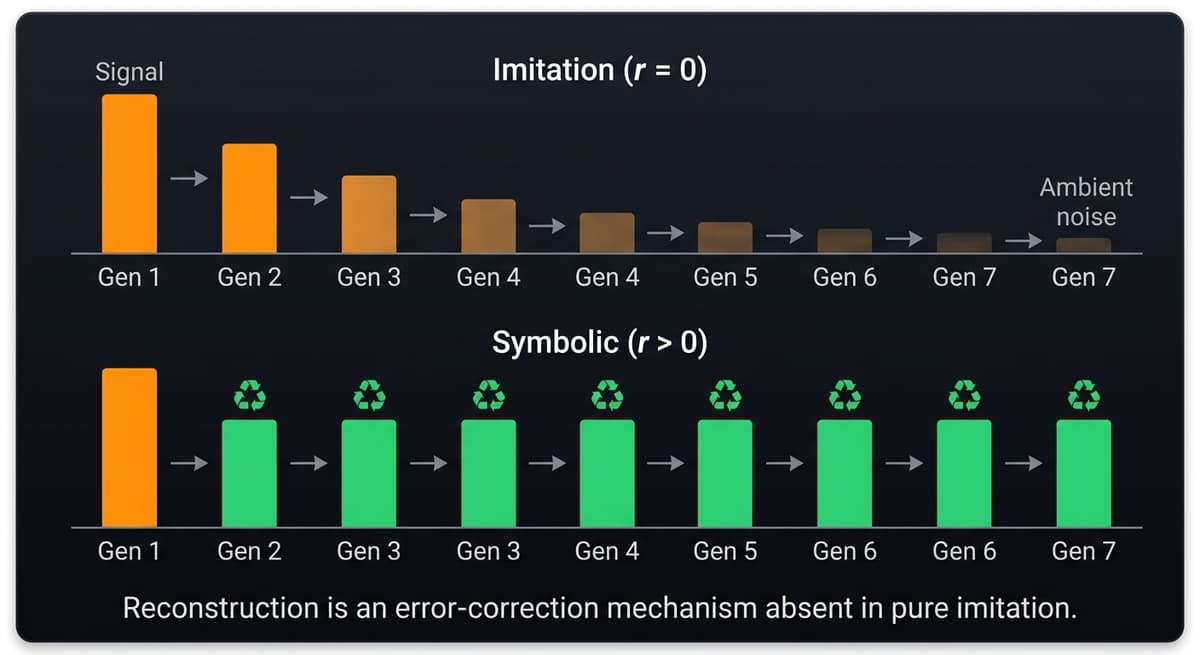
Break 2: cultural transmission is reconstructive, not replicative. An enzyme copies DNA mechanically without "understanding" it. A human apprentice reconstructs the procedure using their own knowledge and intuitions. Claidière, Scott-Phillips, and Sperber (2014) argue that cultural transmission isn't Darwinian replication at all — it's attraction toward cognitive fixed points [6]. The receiver actively fills in gaps and fixes errors, at least for content they intuitively understand.
Break 3: cultural isn't constant — it depends on the content. Recipes survive millennia with barely any drift. Quantum mechanics evaporates from a population in a few generations without formal institutions to maintain it. The fidelity is domain-dependent.
So the honest version of Eigen for culture isn't . It's something like:
where is the raw fidelity of the channel and is the probability that the receiver reconstructs a corrupted unit correctly, based on how well they understand the domain.
The cultural becomes:
For — pure imitation, no understanding — this collapses back to standard Eigen. For , and .
And here's the punchline: the key transition in the Symbolic Filter isn't just "higher q." It's the jump from to .
A crow copies opaque blocks with . A human with compositional language has — they can check internal consistency, infer missing pieces, and correct errors. That's the game-changer. Not better copying. Understanding what you're copying.
The demographic lever
There's a variable I initially underestimated that turns out to be crucial: network size.
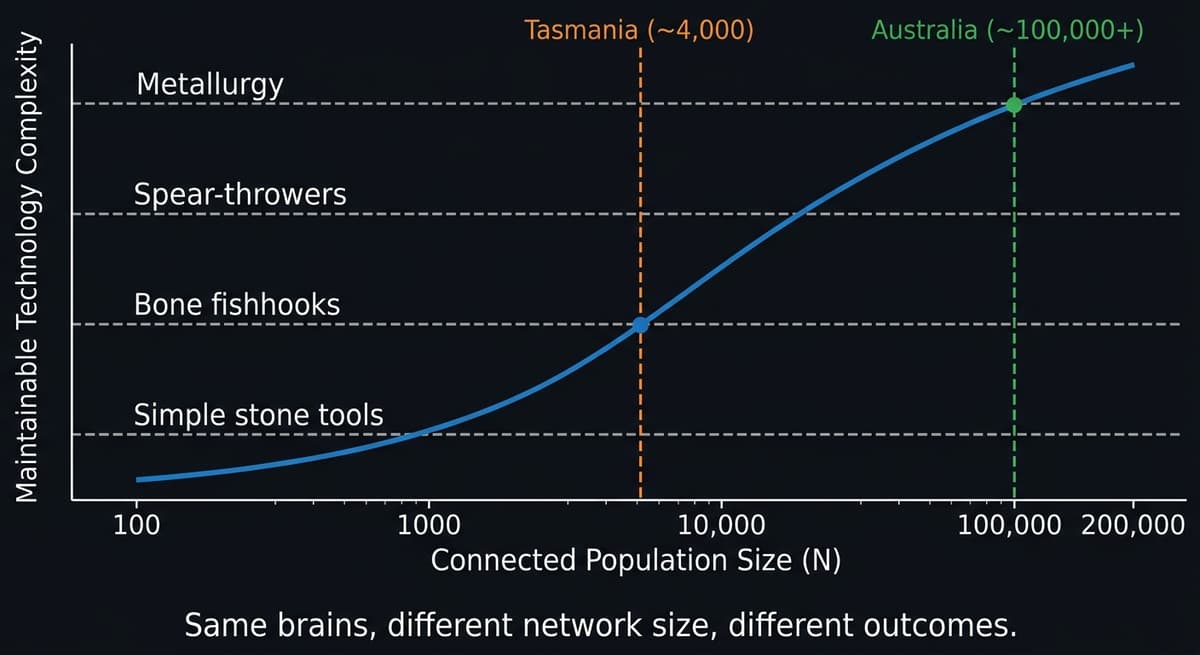
Joseph Henrich (2004) built a model, grounded in the Price equation, that explains one of the weirdest things in archaeology: why the Tasmanians lost technology [4]. When rising seas cut Tasmania off from mainland Australia about 10,000 years ago, the isolated population of ~4,000 people progressively lost bone fishhooks, spear-throwers, boomerangs, and complex fishing tools over the following millennia.
Henrich's equation is [4]:
where is mean skill level, is interconnected population size, is the dispersion of imitative errors, and is the mean loss per copying event. Culture accumulates only when:
Below , you lose technology. Above, you gain it. And gets bigger the more complex the technology is [4].
Tasmania had enough people to keep simple stone tools ( low) but not enough for fancy fishing gear ( high). Exactly what the model predicts.
This plugs directly into my framework. The effective transmission fidelity isn't just about the code — it's about the code times the network:
The takeoff condition becomes:
A proto-language in a band of 30? Probably below threshold. The same proto-language in a connected network of 3,000? Maybe above.
This is where the Neanderthal puzzle fits. They shared our FOXP2 mutations [16], had big brains, and probably had some form of complex communication. But they lived in smaller, less connected groups [15]. Maybe they had the but not the .
The Symbolic Filter becomes less magical and more emergent: not one miraculous event, but the convergence of cognitive capacity and social scale. Both necessary. Neither sufficient. The rarity is in the product.
What triggered the bootstrap?
I'd be dishonest if I just said "co-evolutionary bootstrap, therefore rare" and moved on. That's moving the mystery, not solving it. So: what actually triggered the loop?
Terrence Deacon nailed the paradox in The Symbolic Species (1997): symbolic thought needs language, but language needs symbolic thought [14]. The solution is co-evolution — each increment enables the next. But something had to kick-start the cycle.
The best story I can piece together from the literature involves three factors converging:
Ecological pressure. Mid-Pleistocene climate change turned forests into savannas, pushing hominins toward collaborative hunting where cooperation wasn't optional — it was obligate. Tomasello argues this selected for shared intentionality: the motivation and capacity to share mental states with others [9][17].
Neural hardware. The anomalous expansion of the prefrontal cortex gave hominins the substrate for inhibitory control — the ability to suppress immediate, obvious associations in favor of arbitrary symbolic ones. This is both the prerequisite for cooperation (delaying gratification) and for symbolic reference (suppressing the literal to grasp the abstract) [14].
Demographic scale. Bigger, more connected groups meant more innovations to share, more value in sharing well, and therefore stronger selection for symbolic capacity [4][15].
The bootstrap fired when all three were present simultaneously. Remove any one, and the loop doesn't start. Not magic — but contingent. And contingent things are rare.
Plugging into the Bayesian framework
Let me connect this to the formal machinery of Snyder-Beattie et al. (2021) [2].
Their model treats civilization as the product of sequential evolutionary transitions, each with a Poisson rate :
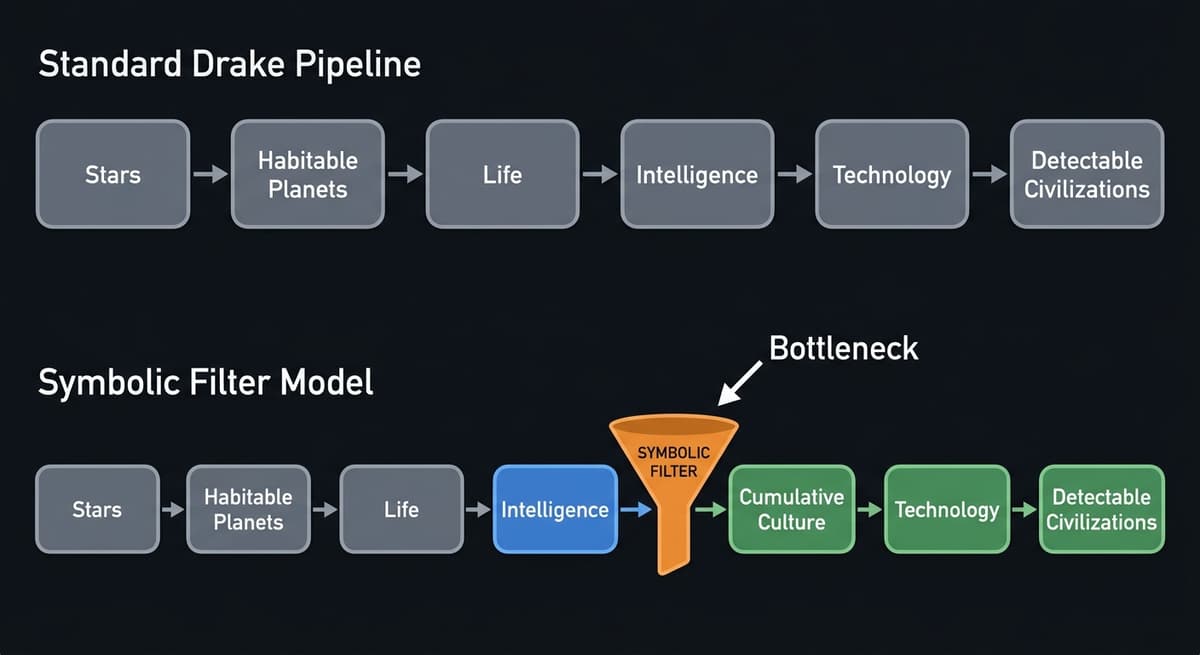
They bundle intelligence and language into one transition () [2]. I'm proposing to split it:
- : rate of emergence of general intelligence
- : rate of emergence of high-fidelity symbolic transmission
From convergent evolution on Earth, is clearly high — intelligence evolved many times independently.
But is the joint probability of multiple independent requirements:
Each factor alone might be reasonable. The product is tiny. And if , it becomes the rate-limiting step in the whole chain.
Plugging into Drake:
If is infinitesimal, you get a universe full of intelligent life ( high) and zero detectable civilizations ().
What this explains and what it doesn't
I want to be straight about the limits of this idea.
This hypothesis does not explain why the transition from to is improbable at a fundamental level. It relocates the filter to , which is useful but not a full explanation. It tells you where to look, not why what you find there is rare.
What it does do:
- Splits two transitions that everyone else treats as one [2][7], showing they probably have very different probabilities.
- Points to transmission fidelity — not intelligence — as the bottleneck.
- Gives the threshold a formal basis (bifurcation, not hand-waving).
- Names the qualitative leap: , from copying to understanding.
- Links the filter to demography via Henrich [4], making it testable.
- Predicts something specific for SETI: lots of intelligence out there, very little technology.
The honest counterarguments
N=1. One planet, one case of language. Any statistics from a single datapoint are fragile. Snyder-Beattie et al. use uninformative priors to help [2], but the structural problem remains.
The filter might be earlier. If abiogenesis is already vanishingly rare, nothing I've said matters. But the argument cuts both ways: if abiogenesis is easy (its early emergence on Earth suggests it might be), the filter must be later.
The threshold might be softer than the math suggests. My ODE assumes constant parameters. Real populations might hover around for millennia, oscillating in and out. The bifurcation is real but probably noisier than the clean model implies. Agent-based simulations would help.
Convergence might do it. Maybe the same selective pressures produce language-like systems on every Earth-like planet. But convergence works for eyes and wings — physical structures with tight engineering constraints [18]. It's less clear it works for cognitive architectures requiring very specific combinations of neural substrate, social pressure, and ecological niche. Eyes evolved independently dozens of times on Earth. Language evolved once.
There might be other paths. Chemical compositionality, distributed biological computation, cognitive symbiosis — maybe there are routes to cumulative culture I can't imagine. The hypothesis is that exists regardless of the path. But I can't prove there isn't a shortcut.
The Eigen analogy is just an analogy. I've been explicit about this — the informational constraint is real, but the mechanics in culture are different from molecular biology [6][12][13]. The formulation with reconstruction term is a simplified model, not a proven law. A rigorous treatment would need correlated-error models — hidden Markov chains or hierarchical Bayesian frameworks. That's future work.
The picture
If this is right, here's the universe:
- Life emerges — maybe common, maybe rare. Not our filter.
- Life gets complex — eukaryogenesis, multicellularity. Known bottlenecks [2][7].
- Intelligence shows up — problem-solving, tools, social cognition. Probably common ( high). Corvids and octopuses suggest it's not that hard.
- THE FILTER. A transmission system that crosses . Needs cognitive capacity (), symbolic compositionality (high ), and demographic scale ( sufficient) — all at once [4][5][14]. Happened once in 4 billion years here.
- Cumulative culture ignites — exponential then logistic [11]. But only after step 4.
- Civilization — science, math, engineering, radio telescopes. All downstream of intergenerational accumulation [3][10].
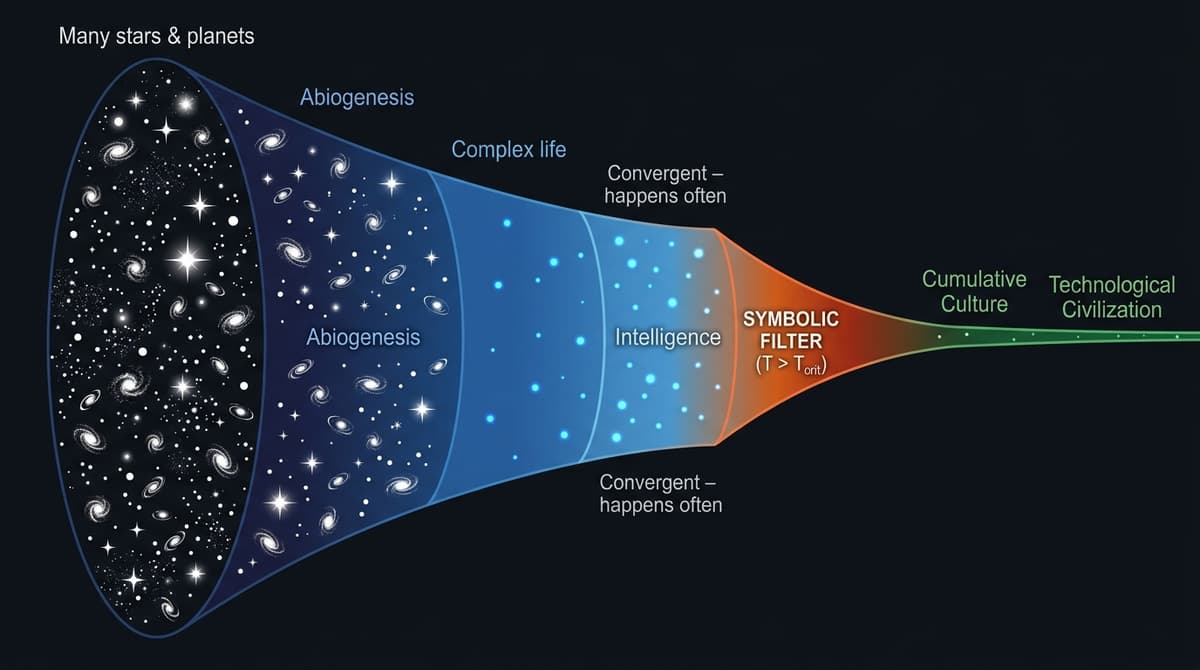
A galaxy full of brilliant minds stuck at the asymptote of , unable to ignite the cultural exponential. Intelligence everywhere, civilization nowhere.
Maybe the most silent of all filters is this: not the impossibility of thinking, but the impossibility of saying it.
This is a hypothesis, not a theory. The formalization is preliminary. The Eigen analogy is an analogy. The models are simplified. But the direction — separating intelligence from symbolic transmission, locating the filter at the fidelity threshold — seems genuinely unexplored. If you want to collaborate on making this rigorous, I'd love to hear from you.
References
[1] Hanson, R. (1998). "The Great Filter — Are We Almost Past It?" Manuscript, George Mason University.
[2] Snyder-Beattie, A.E., Sandberg, A., Drexler, K.E. & Bonsall, M.B. (2021). "The Timing of Evolutionary Transitions Suggests Intelligent Life is Rare." Astrobiology, 21(3), 265–278.
[3] Caldwell, C.A. & Millen, A.E. (2008). "Studying Cumulative Cultural Evolution in the Laboratory." Phil. Trans. R. Soc. B, 363, 3529–3539.
[4] Henrich, J. (2004). "Demography and Cultural Evolution: How Adaptive Cultural Processes Can Produce Maladaptive Losses — The Tasmanian Case." American Antiquity, 69(2), 197–214.
[5] Lewis, H.M. & Laland, K.N. (2012). "Transmission Fidelity is the Key to the Build-up of Cumulative Culture." Phil. Trans. R. Soc. B, 367, 2171–2180.
[6] Claidière, N., Scott-Phillips, T.C. & Sperber, D. (2014). "How Darwinian is Cultural Evolution?" Phil. Trans. R. Soc. B, 369, 20130368.
[7] Mills, D.B. et al. (2025). "A Reassessment of the 'Hard-Steps' Model for the Evolution of Intelligent Life." Science Advances, 11, eads5698.
[8] Mesoudi, A. & Thornton, A. (2018). "What is Cumulative Cultural Evolution?" Proc. R. Soc. B, 285, 20180712.
[9] Tomasello, M., Carpenter, M., Call, J., Behne, T. & Moll, H. (2005). "Understanding and Sharing Intentions: The Origins of Cultural Cognition." Behavioral and Brain Sciences, 28(5), 675–691.
[10] O'Madagain, C. & Tomasello, M. (2022). "Shared Intentionality, Reason-Giving and the Evolution of Human Culture." Phil. Trans. R. Soc. B, 377, 20200320.
[11] Mesoudi, A. (2011). "Variable Cultural Acquisition Costs Constrain Cumulative Cultural Evolution." PLoS ONE, 6(3), e18239.
[12] Eigen, M. (1971). "Selforganization of Matter and the Evolution of Biological Macromolecules." Naturwissenschaften, 58(10), 465–523.
[13] Stevenson, J.D. (2024). "Modelling the Structure and Evolution of Cultural Information as Quasispecies." BioSystems, 235, 105093.
[14] Deacon, T.W. (1997). The Symbolic Species: The Co-Evolution of Language and the Brain. W.W. Norton.
[15] Sanz, C.M. et al. (2022). "The Origins of Human Cumulative Culture." Phil. Trans. R. Soc. B, 377, 20200317.
[16] Atkinson, E.G. et al. (2018). "No Evidence for Recent Selection at FOXP2 among Diverse Human Populations." Cell, 174(6), 1424–1435.
[17] Dunér, D. (2017). "On the Plausibility of Intelligent Life on Other Worlds." Environmental Humanities, 9(2), 433–453.
[18] Hauser, M.D., Chomsky, N. & Fitch, W.T. (2002). "The Faculty of Language: What Is It, Who Has It, and How Did It Evolve?" Science, 298(5598), 1569–1579.
[19] Carter, B. (1983). "The Anthropic Principle and its Implications for Biological Evolution." Phil. Trans. R. Soc. Lond. A, 310, 347–363.
[20] Hurford, J.R. (2004). "Human Uniqueness, Learned Symbols and Recursive Thought." European Review, 12(4), 551–565.
[21] Vakoch, D.A. (ed.) (2022). Xenolinguistics: Toward a Science of Extraterrestrial Language. Routledge.